> ## Documentation Index
> Fetch the complete documentation index at: https://docs.ame.network/llms.txt
> Use this file to discover all available pages before exploring further.
# Overview
> Learn about ame component
Ame Component is an onchain component based on EIP-7654 that decomposes complex onchain processes into independent, composable, reusable, and highly adaptable functional units.
## **Rationale**
### **Type of request method**
In order to enable the client to operate the contract in a standardized and predictable way, three request method types `GET`, `POST`, and `PUT` are set. The functions of each need to be defined in these three types to facilitate the contract caller to understand and process the information required for the request. However, there is no `DELETE` operation type because deleting data in the contract is an inefficient operation. Developers can add a `PUT` request method by themselves to set the data to be valid and invalid, and only return valid data in the `GET` method.
### **Request method parameter type**
Some functions are defined in each request method type. They all include request parameter data type and response parameter data type, which need to be set in the `constructor` and then obtained according to the method name through `getMethodReqAndRes`. The data type of the parameter is defined by the enumeration of the data type. When processing the request parameter, `abi.decode` is used to decode according to the request parameter type and the request value. When returning the response, `abi.encode` is used to encode according to the response value and the response parameter type. In addition, we can get the method usage instructions by calling `getMethodInstruction`.
## Interface
```solidity IComponent.sol theme={null}
// SPDX-License-Identifier: CC0-1.0
pragma solidity >=0.8.0;
import "./Types.sol";
interface IComponent{
/**
* Requested method type.
* GET, POST, PUT, OPTIONS
*/
enum MethodTypes{
GET,
POST,
PUT,
OPTIONS
}
/**
* Response data event.
* @param _response is the response value of the post request or put request.
*/
event Response(bytes _response);
/**
* Get method names based on request method type.
* @param _methodTypes is the request method type.
* @return Method names.
*/
function getMethods(MethodTypes _methodTypes)external view returns (string[] memory);
/**
* Get the data types of request parameters and return parameters based on the requested method name.
* @param _methodName is the method name.
* @return Data types of request parameters and return parameters.
*/
function getMethodReqAndRes(string memory _methodName) external view returns(Types.Type[] memory ,Types.Type[] memory );
/**
* Get the instruction of method based on the requested method name.
* @param _methodName is the method name.
* @return instruction
*/
function getMethodInstruction(string memory _methodName) external view returns(string memory);
/**
* Request the contract to retrieve records.
* @param _methodName is the method name.
* @param _methodReq is the method type.
* @return The response to the get request.
*/
function get(string memory _methodName,bytes memory _methodReq)external view returns(bytes memory);
/**
* Request the contract to create a new record.
* @param _methodName is the method name.
* @param _methodReq is the method type.
* @return The response to the post request.
*/
function post(string memory _methodName,bytes memory _methodReq)external payable returns(bytes memory) ;
/**
* Request the contract to update a record.
* @param _methodName is the method name.
* @param _methodReq is the method type.
* @return The response to the put request.
*/
function put(string memory _methodName,bytes memory _methodReq)external payable returns(bytes memory);
/**
* Supported request method types.
* @return Method types.
*/
function options()external returns(MethodTypes[] memory);
}
```
The library `Types.sol` contains an enumeration of Solidity types used in the above interfaces.
```solidity Types.sol theme={null}
// SPDX-License-Identifier: CC0-1.0
pragma solidity >=0.8.0;
library Types {
enum Type {
BOOL, INT8, INT16, INT24, INT32, INT40, INT48, INT56, INT64, INT72, INT80, INT88, INT96, INT104, INT112, INT120, INT128, INT136, INT144, INT152, INT160, INT168, INT176, INT184, INT192, INT200, INT208, INT216, INT224, INT232, INT240, INT248, INT256, UINT8, UINT16, UINT24, UINT32, UINT40, UINT48, UINT56, UINT64, UINT72, UINT80, UINT88, UINT96, UINT104, UINT112, UINT120, UINT128, UINT136, UINT144, UINT152, UINT160, UINT168, UINT176, UINT184, UINT192, UINT200, UINT208, UINT216, UINT224, UINT232, UINT240, UINT248, UINT256, ADDRESS, BYTES1, BYTES2, BYTES3, BYTES4, BYTES5, BYTES6, BYTES7, BYTES8, BYTES9, BYTES10, BYTES11, BYTES12, BYTES13, BYTES14, BYTES15, BYTES16, BYTES17, BYTES18, BYTES19, BYTES20, BYTES21, BYTES22, BYTES23, BYTES24, BYTES25, BYTES26, BYTES27, BYTES28, BYTES29, BYTES30, BYTES31, BYTES32, BYTES, STRING, INT8_ARRAY, INT16_ARRAY, INT24_ARRAY, INT32_ARRAY, INT40_ARRAY, INT48_ARRAY, INT56_ARRAY, INT64_ARRAY, INT72_ARRAY, INT80_ARRAY, INT88_ARRAY, INT96_ARRAY, INT104_ARRAY, INT112_ARRAY, INT120_ARRAY, INT128_ARRAY, INT136_ARRAY, INT144_ARRAY, INT152_ARRAY, INT160_ARRAY, INT168_ARRAY, INT176_ARRAY, INT184_ARRAY, INT192_ARRAY, INT200_ARRAY, INT208_ARRAY, INT216_ARRAY, INT224_ARRAY, INT232_ARRAY, INT240_ARRAY, INT248_ARRAY, INT256_ARRAY, UINT8_ARRAY, UINT16_ARRAY, UINT24_ARRAY, UINT32_ARRAY, UINT40_ARRAY, UINT48_ARRAY, UINT56_ARRAY, UINT64_ARRAY, UINT72_ARRAY, UINT80_ARRAY, UINT88_ARRAY, UINT96_ARRAY, UINT104_ARRAY, UINT112_ARRAY, UINT120_ARRAY, UINT128_ARRAY, UINT136_ARRAY, UINT144_ARRAY, UINT152_ARRAY, UINT160_ARRAY, UINT168_ARRAY, UINT176_ARRAY, UINT184_ARRAY, UINT192_ARRAY, UINT200_ARRAY, UINT208_ARRAY, UINT216_ARRAY, UINT224_ARRAY, UINT232_ARRAY, UINT240_ARRAY, UINT248_ARRAY, UINT256_ARRAY, ADDRESS_ARRAY, BYTES1_ARRAY, BYTES2_ARRAY, BYTES3_ARRAY, BYTES4_ARRAY, BYTES5_ARRAY, BYTES6_ARRAY, BYTES7_ARRAY, BYTES8_ARRAY, BYTES9_ARRAY, BYTES10_ARRAY, BYTES11_ARRAY, BYTES12_ARRAY, BYTES13_ARRAY, BYTES14_ARRAY, BYTES15_ARRAY, BYTES16_ARRAY, BYTES17_ARRAY, BYTES18_ARRAY, BYTES19_ARRAY, BYTES20_ARRAY, BYTES21_ARRAY, BYTES22_ARRAY, BYTES23_ARRAY, BYTES24_ARRAY, BYTES25_ARRAY, BYTES26_ARRAY, BYTES27_ARRAY, BYTES28_ARRAY, BYTES29_ARRAY, BYTES30_ARRAY, BYTES31_ARRAY, BYTES32_ARRAY, BYTES_ARRAY, STRING_ARRAY
}
}
```
## Specifications
* `getMethods` Get method names based on request method type.
* `getMethodReqAndRes` Get the data types of request parameters and return parameters based on the requested method name.
* `getMethodInstruction` Get the instruction of method.
* `get` Request the contract to retrieve records.
* `post` Request the contract to create a new record.
* `put` Request the contract to update a record.
* `options` Supported request method types.
The `methodRequests` and `methodResponses` are used to define the request parameter type and response data type of Method. Types.sol is a data type Library, which contains all data types of solidity.
```solidity theme={null}
mapping (string=>Types.Type[]) methodRequests;
mapping (string=>Types.Type[]) methodResponses;
```
Method Types has 4 request types, GET, POST, PUT, OPTIONS. `methods` is used to store the method name array of each request type.
```solidity theme={null}
mapping (MethodTypes=>string[]) methods;
```
`instructions` is used to store method instructions
```solidity theme={null}
mapping(string => string) instructions;
```
The `options` function will return the request method type supported by the component.
```solidity theme={null}
function options()public pure returns(MethodTypes[] memory){
MethodTypes[] memory methodTypes=new MethodTypes[](4);
methodTypes[0]=MethodTypes.GET;
methodTypes[1]=MethodTypes.POST;
methodTypes[2]=MethodTypes.PUT;
methodTypes[3]=MethodTypes.OPTIONS;
return methodTypes;
```
The `setMethod` is used to set the request parameter type and response data type of the method.
```solidity theme={null}
function setMethod(string memory _methodName,MethodTypes _methodType,Types.Type[] memory _methodReq,Types.Type[] memory _methodRes) private {
methods[_methodType].push(_methodName);
methodRequests[_methodName]=_methodReq;
methodResponses[_methodName]=_methodRes;
}
```
The `getMethods` returns the response method names according to the request type.
```solidity theme={null}
function getMethods(MethodTypes _methodTypes)public view returns (string[] memory){
return methods[_methodTypes];
}
```
The `getMethodReqAndRes` is used to obtain the request parameter type and response value type of the method based on the method name.
```solidity theme={null}
function getMethodReqAndRes(string memory _methodName)public view returns(Types.Type[] memory ,Types.Type[] memory ){
return(
methodRequests[_methodName],
methodResponses[_methodName]
);
}
```
The `getMethodInstruction` is used to query the usage of method.
```solidity theme={null}
function getMethodInstruction(string memory _methodName)
public
view
returns (string memory)
{
return instructions[_methodName];
}
```
Implement the functions of each method in `get`, `post`, and `put` .
```solidity theme={null}
function get(string memory _methodName,bytes memory _methodReq)public pure returns(bytes memory){
return abi.encode(_methodName,_methodReq);
}
function post(string memory _methodName,bytes memory _methodReq)public payable returns(bytes memory){
return abi.encode(_methodName,_methodReq);
}
function put(string memory _methodName,bytes memory _methodReq)public payable returns(bytes memory){
return abi.encode(_methodName,_methodReq);
}
```
## Workflow
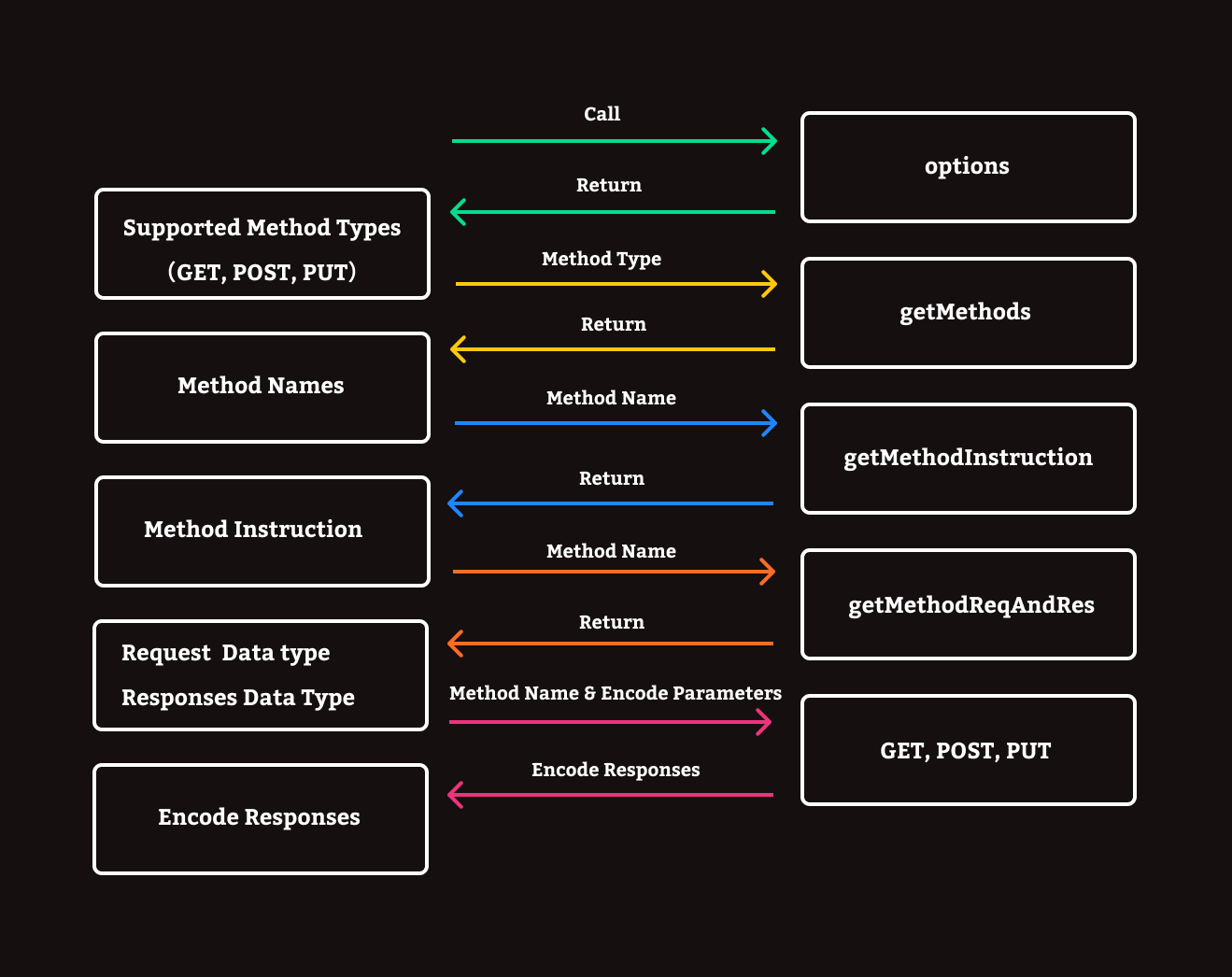 Call `options` to obtain supported request method types.
Call `getMethods` to obtain the request method name.
Call `getMethodInstruction` to obtain the request method instruction.
Call `getMethodReqAndRes` to obtain the request parameter data type and response value data type.
Encode request parameters and call `get`, `post`, and `put`.
Decode response value.
Call `options` to obtain supported request method types.
Call `getMethods` to obtain the request method name.
Call `getMethodInstruction` to obtain the request method instruction.
Call `getMethodReqAndRes` to obtain the request parameter data type and response value data type.
Encode request parameters and call `get`, `post`, and `put`.
Decode response value.